
What Are Skunks?
Get A Free Quote
We are affordable Pest Control Service in GTA & Surroundings Areas.
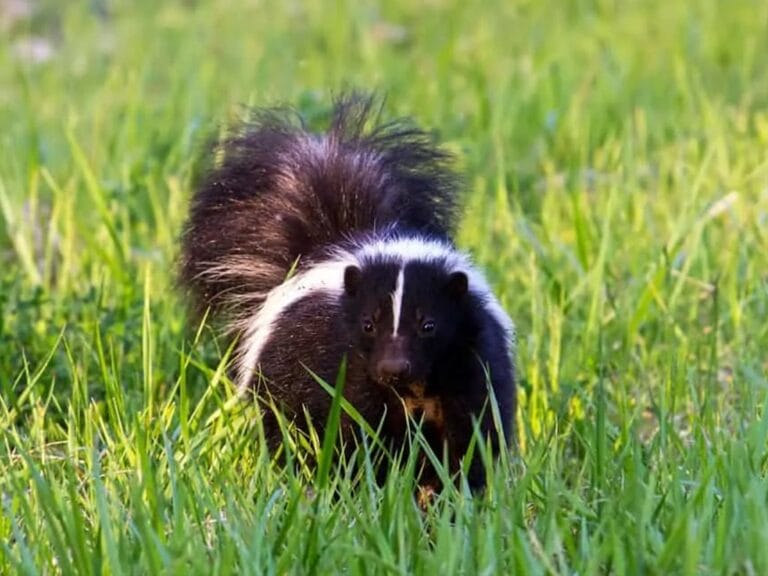
What are skunks? They are small mammals best known for their strong-smelling spray. About the size of a house cat, skunks have black fur with white stripes and a big bushy tail. They live across North America and are common in suburban neighbourhoods. Skunks are shy animals that try to avoid people.
When a skunk feels scared or trapped, it sprays an oily liquid called musk. This spray can reach up to 15 feet. The smell is very hard to wash off skin, clothes, and pets. Before spraying, a skunk warns you by stomping its feet and raising its tail. These warnings give you time to back away.
Skunks are nocturnal, so you will mostly see them at night. They dig small holes in lawns while hunting for grubs. They also den under decks, porches, and sheds. This guide explains everything about skunks. what they look like, why they spray, and how to keep them away from your home.
There are 12 skunk species in the world. All of them live in North and South America. The species most common in Ontario is the striped skunk (Mephitis mephitis).
What Does a Skunk Look Like?
- Colour: Black fur with white stripes running down the back. Some skunks have white spots instead of stripes.
- Size: About the size of a house cat, a skunk typically measures 15 to 30 inches long, including its tail, and weighs around 4 to 12 pounds.
- Tail: A big, bushy tail. It stands up when the skunk feels threatened.
- Smell: A strong, bad odour near your home, especially at night. This is the clearest sign a skunk is close.

Skunk facts at a glance
| Fact | Detail |
|---|---|
| Species in Ontario | Striped skunk (Mephitis mephitis) |
| Length | 15–30 inches, including tail |
| Weight | 4–12 pounds |
| Active hours | Night (nocturnal) |
| Winter behaviour | Light sleep (torpor), not full hibernation |
| Lifespan | 2–3 years in the wild |
| Baby skunks | Called kits |
Learn more about living with skunks from the Toronto Wildlife Centre.
What Types of Skunks Live in Ontario?

In Ontario, you will almost always meet one type: the striped skunk (Mephitis mephitis). It is the only skunk species commonly found in the GTA.
Here are the five main skunk species in North America:
| Species | Scientific name | Where it lives |
|---|---|---|
| Striped skunk | Mephitis mephitis | All across Canada and the US, including Ontario |
| Eastern spotted skunk | Spilogale putorius | Southeastern United States |
| Western spotted skunk | Spilogale gracilis | Western US and Mexico |
| Hooded skunk | Mephitis macroura | Southwestern US and Mexico |
| American hog-nosed skunk | Conepatus leuconotus | Southern US and Mexico |
Only the striped skunk lives in Ontario. The other species live farther south or west and are not found in the GTA. Striped skunks vary a little. Some have two thick white stripes. Others have one thin stripe or white spots. All of them spray, and all of them behave the same way around homes.
What Do Skunks Eat?
Skunks are omnivores. This means they eat both plants and small animals. Their favourite food is grubs, fat white larvae that live in lawns. They also eat insects, worms, fallen fruit, berries, and eggs. Near homes, they love open garbage, compost, and pet food left outside. A skunk can eat a large number of grubs in one night. This helps your lawn, but the digging they do to find grubs can damage the grass.
Where Do Skunks Live?
Skunks make dens in quiet, sheltered spots. Around homes, they choose spaces under decks, porches, sheds, and wood piles. They may also use old burrows made by other animals, such as squirrels. Skunks are nocturnal. They sleep during the day and come out after dark to eat. They usually travel alone, not in groups.
What are skunks doing during the winter? In the GTA, they do not fully hibernate. Instead, they fall into a deep sleep called torpor. They wake on milder nights to look for food, then go back to sleep. In late winter and spring, skunks become more active. This is mating season. You may see or smell them more often around your home at this time.
In the GTA, skunks are most common in suburban neighbourhoods. Areas with many decks, sheds, and wood piles give them easy shelter. They also thrive near ravines, parks, and golf courses. Open garbage and lawn grubs give them easy food. Suburbs across Toronto, Mississauga, Brampton, Milton, and Oakville all have ideal skunk habitat.
What Is the Skunk Life Cycle?
How Long Do Skunks Live?
Wild skunks live short lives. Most live only 2 to 3 years in the wild. Many young skunks die in their first year. Cars are a major killer. Predators like owls, foxes, and coyotes also hunt them. Disease and harsh winters take more lives. In captivity, with steady food and medical care, a skunk can live 8 to 10 years.
When Do Skunks Mate?
Skunks mate once a year. Mating season runs from February to March. During this time, males travel long distances to find females. Males may fight each other for a mate. This is why you see more skunks in late winter. After mating, the male leaves. He does not help raise the babies.
When Are Baby Skunks Born?
After mating, the female is pregnant for about 60 days. She prepares a warm den lined with leaves and grass. Babies are born in May or June. A mother usually has 4 to 6 babies, called kits. Litters can be as small as 2 or as large as 10.
How Do Baby Skunks Grow?
Kits are born blind, deaf, and helpless. Their soft fur already shows faint stripes. Their eyes open after about 3 weeks. At 6 weeks, they start eating solid food. By 6 to 8 weeks, they follow their mother outside at night. She teaches them to find grubs and insects. Young skunks can spray at about one month old, but their aim is weak. The family stays together through the summer. In autumn, the young skunks leave to live on their own.
This is why May to July needs extra care during removal. If babies are inside the den, they must be reunited with their mother never left behind.
Why Do Skunks Spray?
Skunks spray to protect themselves. They cannot run fast or fight well. Their spray is their main defence. Before spraying, a skunk warns you. It stomps its front feet. It raises its bushy tail. It may even do a short handstand. These are clear signs to back away.
The spray is a yellow, oily liquid called musk. It can reach up to 15 feet with good aim. The smell can linger for days. A skunk can only spray a few times before it runs out. It then needs about 10 days to make more. That is why it usually warns first instead of spraying right away.
What Attracts Skunks to Your Yard?
So, what are skunks after when they visit your yard? Easy food and shelter:
- Open garbage cans or overflowing bins
- Pet food and water bowls left outside overnight
- Grubs living in the grass
- Fallen fruit under trees
- Open spaces under decks, porches, and sheds
If your yard has these, skunks have a reason to stay.
What Are the Signs of a Skunk on Your Property?
- Strong bad smell, especially at night.
- Small cone-shaped holes in your lawn (skunks dig for grubs).
- Garbage cans knocked over or trash scattered.
- Five-toed tracks near gardens, decks, or fences.
- A den opening Check under your deck, porch, or shed for a small dug-out hole.
If you notice two or more of these signs, a skunk is likely living nearby.
How Can You Keep Skunks Away? 6 Simple Tips
- Cover garbage tightly. Use cans with secure lids. Lock them if you can.
- Bring pet food inside at night. Do not leave water bowls out either.
- Treat your lawn for grubs. Grubs are their favourite food. Fewer grubs mean fewer skunks.
- Seal gaps Use strong wire mesh around decks, porches, and sheds. Bury it at least 12 inches deep and bend the bottom outward in an L-shape to stop skunks from digging underneath.
- Pick up fallen fruit from your yard regularly.
- Turn on outdoor lights at night. Skunks prefer the dark and avoid bright areas.
Wondering what skunks are afraid of? Bright lights and strong scents top the list — which is exactly why these tips work.
What Should You Do If You See a Skunk?
Stay calm and keep your distance. Do not approach it. Do not try to chase it away. Give it a clear path to leave. If it is simply passing through, it will move on. If it has made a den on your property, do not try to trap it yourself. A scared skunk sprays, and skunks can carry rabies.
Keep pets indoors until the skunk leaves. Then check your yard for dens and seal the entry points.
Our Guarantee
Acme Pest Solutions is dedicated to providing exceptional pest control services focusing on customer satisfaction. We aim to exceed industry standards by delivering high-quality work. We stand behind our work with a guarantee for each job completed, giving customers peace of mind. We are committed to ensuring seamless and high-quality service and will return to make things right if any issues arise.
How Much Does Skunk Removal Cost in the GTA?
Skunk removal cost in the GTA depends on three things: where the den is, how easy it is to reach, and whether entry points need sealing. A simple removal costs less than a job that needs wire-mesh exclusion work around the foundation. If spray got inside your home, odour treatment is usually quoted separately.
As a ballpark, basic humane skunk removal in the GTA typically costs between $300 and $650. Larger jobs that need trenching and wire-mesh exclusion around a big deck can run $700 to $1,500 or more, depending on the size of the area. Prices vary by company and situation.
The fastest way to know your exact cost is a free quote. Acme Pest Solutions gives a clear upfront price before any work begins, with no hidden fees. If you need to get rid of skunks, call 416-453-2444 for a free quote.
What Are Ontario's Skunk Removal Laws?
In Ontario, it is illegal to trap and relocate wildlife without following the Fish and Wildlife Conservation Act. You cannot just trap a skunk and release it in another area. That breaks the law and harms the animal.
The law also limits how far you can relocate a wild animal. If you catch one alive, you must release it within one kilometre of where you caught it and within 24 hours.This stops disease from spreading and gives the animal the best chance to survive in territory it knows.
This is another reason to call a professional. They use legal methods, like one-way doors that let skunks leave on their own. They handle every step within the rules.
How Does Humane Skunk Removal Work?
A professional removes skunks safely in three steps:
- Inspection: The technician finds the den and all entry points.
- Humane removal: One-way doors let skunks leave but not re-enter. Babies are always kept with their mother.
- Sealing: Entry points are closed with strong wire mesh so skunks cannot come back. Skunks are expert diggers, so mesh on the surface is not enough. Professionals bury the mesh at least 12 inches deep and extend it 12 inches outward in an L-shape. This stops skunks from digging under the barrier.
No poisons. No kill traps. The skunk leaves on its own and cannot return.
Timing matters. May to July is baby skunk season. If a one-way door is fitted while kits are still inside the den, the mother leaves but the babies starve. This causes a terrible smell and fly problems. A professional always checks the den for kits first. If babies are found, they are removed by hand and kept warm in a reunion box until they can be safely reunited with the mother outside.
Case Study: A Typical Skunk Removal in the GTA
Here is what a standard skunk job looks like from start to finish.
The problem: A homeowner noticed a strong smell near the back door every night. The lawn had small cone-shaped holes. At dusk, they saw a skunk slip under the deck.
The inspection: The technician found a den under the deck with one entry point. Tracks and droppings confirmed skunks, not raccoons. One side of the deck had an open gap.
The solution: One-way doors were fitted over the entry point. The skunk left on its own within a couple of nights. The technician then sealed the gap with strong wire mesh.
The result: No more smell. No more digging. With the entry sealed, the skunks could not return. Most jobs like this are done within a week, from inspection to sealing.
Skunk FAQs
What should I do if a skunk sprays my dog?
Keep your dog outside so the smell does not spread indoors. Check their eyes — if they look red or irritated, rinse gently with clean water. Wash your dog with this exact mix: 1 quart of 3% hydrogen peroxide, 1/4 cup of baking soda, and 1 teaspoon of liquid dish soap. Work it into the fur, wait 5 minutes, then rinse well. This works far better than tomato juice. Warning: never store this mix in a closed bottle — gas build-up can make the bottle burst. Always mix it fresh. If your dog was bitten or scratched, call your vet right away.
Do skunks come out during the day?
Skunks are nocturnal and mostly active at night. A skunk out during the day is not always sick — mothers with babies sometimes look for food in daylight. Still, keep your distance. If it looks confused, aggressive, or unsteady on its feet, call a professional, as these can be signs of rabies.
Will skunks leave on their own?
Sometimes. Skunks often use a den for only a few weeks before moving on. But if they find easy food and shelter, they will stay and may return every year. The long-term fix is to remove food sources, seal entry points, and call a professional if skunks have settled in.
Why do skunks smell so bad?
The smell comes from musk, an oily liquid made in glands near the tail. It contains sulphur compounds — the same chemical family that makes rotten eggs smell bad. The oil sticks to skin, fur, and clothes, which is why the odour lasts so long.
Are skunks dangerous?
Skunks are not aggressive, but they can be risky. Their spray causes eye irritation. More seriously, skunks are one of the main carriers of rabies in Ontario. Never touch a skunk, dead or alive. Call a professional if one is living on your property.
What eats skunks?
Few animals hunt skunks because of the spray. Great horned owls are the main predator — they have a poor sense of smell. Foxes, coyotes, and dogs sometimes attack skunks but usually regret it.
How much does skunk removal cost in the GTA?
Humane skunk removal in the GTA typically ranges from $300 to $650 for standard one-way door removal, while full L-mesh exclusion around large decks can reach $700 to $1,500+. For an exact assessment with no hidden fees, Acme Pest Solutions provides upfront on-site quotes at 416-453-2444.
What happens to the skunk after removal?
With humane methods like one-way doors, the skunk simply leaves the den on its own and cannot get back in. No traps, no harm — and babies are always kept with their mother.
Conclusion
Skunks are shy, nocturnal animals that want to be left alone. They help your lawn by eating grubs, but they become a problem when they den under your deck or spray near your home. The best approach is prevention: secure your garbage, remove food sources, seal entry points, and add outdoor light. If a skunk has already settled in, professional removal is the safest and most effective option. In Ontario, it also helps make sure the animal is handled legally and humanely.